

OTC Crypto Exchange Development: How to Build an OTC Trading Platform


OTC crypto exchange development is the process of building software infrastructure for executing large digital-asset trades outside a public exchange order book. Instead of relying on order matching, an institutional OTC platform typically combines Request for Quote (RFQ) workflows, pricing and liquidity aggregation, risk controls, custody, settlement, compliance, and dealer operations. That makes it a different product from a retail centralized exchange (CEX): the core engineering work sits in the quote lifecycle, the financial ledger, and the post-trade flow, not in a matching engine.
This guide explains how these systems work, what components an OTC trading platform needs, how development is typically structured, what drives cost, and what a company should decide before starting a project. It is written for founders, CTOs, product owners, and teams at brokers, exchanges, and licensed crypto service providers who are scoping an OTC platform or an OTC desk for an existing exchange.
What Is OTC Crypto Exchange Development?
OTC crypto exchange development means designing and building the software that lets a business quote, execute, and settle large crypto trades bilaterally, away from a public order book. The “OTC” part describes how trades happen: two parties agree on a price privately, and the rest of the market does not see the order before it is filled.
The reason is practical. A block order on a public book can move the price while it fills and signals intent to everyone watching. An OTC desk quotes a firm price for the full size and takes responsibility for sourcing the liquidity behind it.
Many OTC desks historically ran on chat, spreadsheets, and manual settlement. The software layer turns that into a scalable business: client portals and APIs, dealer tools, an accurate balance ledger, and automated onboarding, compliance, and settlement.
One nuance is worth stating early. “OTC crypto exchange” is the common industry and search term, but most of these products do not function like exchanges in the order-book sense. They work more like electronic OTC trading platforms or dealer desks, where clients receive bilateral quotes from the desk or through connected liquidity providers. This guide uses “OTC platform” for that reason: the core workflow is typically quote-based rather than driven by a central limit order-book matching engine.
How Does an OTC Crypto Trading Platform Work?
An OTC crypto trading platform works through a controlled trade lifecycle: the client requests a price, the platform checks the client and builds a firm quote from its liquidity sources, the client accepts within a time window, and the trade is executed, recorded in the ledger, and settled. The most common execution model for this lifecycle is RFQ.
RFQ-Based Execution
In an RFQ workflow, the client asks for a price on a specific trade instead of placing an order into a book. A typical sequence:
- The client requests a price for an asset pair, side, and size, via portal or API.
- The system checks the account and risk: onboarding status, balance, and credit limits.
- The pricing layer collects market and liquidity data from connected sources and internal inventory.
- A quote is generated: one executable price for the full size, including the desk’s spread.
- The quote is valid for a limited time. It carries an ID and an expiry, after which it cannot be executed.
- The client accepts or rejects by referencing the quote ID before expiry.
- The trade is executed from inventory or through offsetting trades with liquidity providers.
- Balances and settlement are updated: the ledger records the trade immediately, and assets move according to the settlement model.
Two other styles often sit alongside RFQ: streaming execution, which publishes firm two-way prices continuously over WebSocket or FIX for API-driven clients, and dealer-assisted execution, where a human trader works a very large order and books it through the admin console. Many platforms start with RFQ and add these later.
Principal, Agency, and Matched-Principal Models
The second decision that shapes how the platform works is how it participates in execution and where the resulting market risk sits.
In a principal model, the desk is the counterparty. It sells from its own inventory or buys into it, then manages the resulting position, often by hedging on external venues. The desk earns the spread but carries market and inventory risk, so it needs stronger risk controls and hedging logic.
In an agency model, the platform arranges execution between the client and third-party liquidity providers without taking directional inventory risk. In a matched-principal model, the platform may technically become principal on both legs of the transaction, but immediately offsets the client trade with a liquidity provider. The two can look similar from a software perspective, although their legal and regulatory treatment can differ by jurisdiction. In both cases the platform typically earns a fee or markup, carries far less market risk than a principal desk, and depends more on the quality and reliability of its liquidity connections.
Legal treatment differs by jurisdiction. In engineering terms, the difference shows up in the risk engine, hedging logic, and how the ledger represents positions.

OTC Exchange vs Traditional Crypto Exchange
An OTC platform executes trades through quotes agreed between two parties, while a traditional crypto exchange matches buy and sell orders in a public order book.
| Area | OTC Platform | Traditional CEX |
| Execution | RFQ, dealer, or streaming quote | Order book matching |
| Typical trade size | Large or block trades | Any size |
| Price discovery | Quote-based | Public order book |
| Market impact | Designed to minimize it | Large orders can move the book |
| Counterparty model | Bilateral, via desk or liquidity providers | Central order book matching |
| Settlement | Several possible models | Exchange account and ledger |
| Main users | Institutional and business clients | Retail and institutional |
Neither model is better in general. They solve different problems. An order book is efficient for continuous trading of liquid pairs by many participants, and it gives everyone the same public price. An OTC platform is built for the trade that is too large or too sensitive for the book, and for clients who need a negotiated relationship: credit terms, custom settlement, dedicated coverage.
That is why many exchanges run both: an OTC desk gives large clients block execution without disrupting the public book, and can still use the exchange’s own liquidity as a source.
Who Needs an OTC Crypto Trading Platform?
Companies that need an OTC crypto trading platform are usually those serving clients whose trade sizes, compliance needs, or settlement terms do not fit a public order book. The most common profiles are:
Crypto exchanges. An OTC desk for large and institutional trades keeps block orders off the public book and gives the exchange a higher-touch product for its biggest clients.
Crypto brokers. A broker can run an RFQ or dealer model connected to external liquidity, quoting clients a single price while sourcing execution from several providers behind the scenes.
Fintech companies. Payment companies, neobanks, and treasury platforms may need a digital-asset execution layer so that their business or institutional users can convert between fiat, stablecoins, and crypto at size.
VASPs and CASPs. Licensed virtual asset service providers often want proprietary OTC infrastructure alongside custody, brokerage, or payment services, so that execution, compliance, and settlement run on one controlled stack.
Institutional trading businesses. Proprietary desks, market makers, and prime-brokerage style businesses need multi-provider pricing, execution, and settlement infrastructure with detailed risk controls and audit trails.
The common thread is not company size. It is the need to control the quote, the counterparty relationship, and the post-trade process, rather than handing all three to a public venue.
Core Architecture of an OTC Crypto Trading Platform
The core architecture of an OTC crypto trading platform is a set of separate functional layers: client access, dealer operations, trading, pricing, liquidity, risk, ledger, settlement, custody, compliance, and back-office operations. Each layer has a distinct job, and the platform works only if the boundaries between them are clear.
| Layer | Core components | Purpose |
| Client | Portal, onboarding, RFQ interface, APIs | Access and trading |
| Dealer | Dealer and admin console | Manual intervention and operations |
| Trading | RFQ engine, quote management, OMS/EMS | Trade lifecycle |
| Pricing | Market data, liquidity aggregation, spreads | Executable prices |
| Liquidity | Connectors to LPs, exchanges, market makers | Execution depth |
| Risk | Credit, exposure, limits, hedging | Risk control |
| Ledger | Double-entry ledger, reservations, fees | Balance integrity |
| Settlement | Crypto and fiat settlement workflows | Post-trade transfer |
| Custody | Wallet and custodian integrations | Asset security |
| Compliance | KYC/KYB, AML, sanctions, Travel Rule | Regulatory controls |
| Operations | Reporting, reconciliation, audit logs | Back office |
A few relationships between these layers matter more than the list itself.
The RFQ engine is the coordinator. It receives the request, asks the risk layer whether the client can trade, asks the pricing layer for a price, issues the quote with its expiry, and hands accepted trades to the order and execution management system (OMS/EMS). It should hold as little business logic about prices or balances as possible, so that pricing and risk rules can change without touching the quote lifecycle.
Pre-trade risk checks happen before a quote or execution. The platform verifies balances, credit limits and exposure before committing to a price, and critical checks can be revalidated when the client executes the quote. Blocking a request early is far cheaper than unwinding a trade the desk should never have quoted.
The ledger is the source of truth for balances. Every trade, fee, reservation, deposit, and withdrawal is recorded as balanced double-entry postings. This is what makes reconciliation, reporting, and audits possible, and it is the component where design mistakes are most expensive to fix later.
Custody and settlement sit behind the ledger. The ledger says who owns what. Custody holds the actual assets, and settlement moves them when the business rules require it.
Compliance touches several points. Onboarding happens before the client can request a quote, wallet screening happens before deposits and withdrawals, and Travel Rule messaging happens before certain transfers leave the platform.
The dealer console is not an afterthought. Dealers override quotes, book trades negotiated by chat, adjust limits, and approve withdrawals. A platform built only for automated flow pushes operations back into spreadsheets.
For client connectivity, most platforms start with a web portal plus REST and WebSocket APIs. The FIX protocol, maintained by the FIX Trading Community, is common among institutional clients and liquidity providers, and supporting it can be a requirement for certain client segments. Whether it belongs in the first release depends on who the platform serves.
The table is not a mandatory checklist for version one. Architecture depends on the operating model, target clients, jurisdictions, liquidity setup, and settlement model. A broker using two liquidity providers and prefunded accounts needs a much smaller risk and settlement layer than a principal desk offering credit to hedge funds. What should not be skipped, even in a first release, is a correct ledger, clean separation between these domains, and an audit trail for every state change.

Liquidity, Pricing, and Risk Management
Liquidity, pricing, and risk management determine whether an OTC platform can quote competitive prices for large trades without taking losses it cannot control. The three are connected: liquidity defines what prices are available, pricing turns them into a quote, and risk management decides how much exposure the desk can carry while it executes.
Liquidity sources. Liquidity can come from centralized exchange APIs, market makers, institutional liquidity providers, and the desk’s own inventory. Each source has its own pricing, fees, settlement terms, and connector.
Aggregation. The pricing layer normalizes these feeds into one view of available depth. For a given size it can weigh price, depth, fees, each source’s reliability and latency, and current inventory. More sources can mean better prices, and more integration and monitoring work.
Spreads and markups. The client quote is the aggregated reference price plus a spread. Spreads usually vary with trade size, market volatility, the client’s tier or credit profile, and the desk’s inventory position. A desk that is already long an asset can quote more attractively to clients who want to buy it, which reduces inventory without paying fees on an external venue.
Quote expiration. Every quote has a validity window: long enough for the client to decide, short enough that the market cannot move far before execution. There is no universal value; providers set windows by asset, conditions, size, and their own risk policies. Architecturally, expiry must be enforced server-side, expired quotes must never execute, and windows should be configurable per asset and client segment.
Slippage. Underlying prices can move while the desk executes offsetting trades. Pricing should account for expected market impact, and execution needs rules for when prices move beyond an acceptable threshold before confirmation.
Hedging. In a principal model, hedging logic can offset each trade immediately, let positions build within exposure limits before rebalancing, or shift quotes to attract flow that reduces inventory. In a matched-principal model, the offsetting trade with the liquidity provider is part of the execution flow, so failed or partial provider fills need defined handling. In an agency model, the platform primarily manages routing and execution quality rather than its own directional inventory.
Credit and exposure limits. The risk layer tracks each client’s balances, credit lines, and open exposure in real time and blocks requests that would exceed them. For desks offering post-trade settlement, it also monitors unsettled exposure per counterparty.
Custody and Settlement
Custody and settlement define where client assets are held and how they actually move after a trade is agreed. The choice of settlement model affects capital efficiency for clients, counterparty risk for the desk, and a large share of the platform’s integration work. There are three high-level models.
Prefunded settlement. Clients deposit fiat or crypto before they trade. When a trade executes, settlement is an internal ledger movement between balances the platform already controls. This is the simplest model to build and removes most counterparty risk for the desk, but institutional clients may be reluctant to lock up capital on a platform in advance.
Credit or bilateral settlement. Qualified counterparties trade first and settle later under agreed terms, for example at the end of a day or another agreed cycle, by bank transfer and on-chain transactions. This is capital-efficient for clients and common in institutional relationships. It exposes the desk to the risk that a counterparty fails to deliver, so it requires credit limits, exposure monitoring, and a controlled settlement workflow with confirmations and exception handling.
Custodial or off-exchange settlement. Assets stay with a third-party custodian or within an off-exchange settlement (OES) network, and the trading platform receives a mirrored trading balance. Trades are netted and settled between accounts in that network rather than by moving assets on and off the trading venue. Copper ClearLoop and the Fireblocks Network are examples of this infrastructure. This model separates custody from trading-venue exposure, which many institutions now expect, but it requires deep integration between the platform’s ledger, its settlement engine, and the provider’s APIs.
A platform can support more than one model for different client segments. That flexibility should be planned in the ledger design from the start.
Internal ledger is not blockchain settlement. Most trading activity is recorded off-chain in the internal ledger, and no blockchain transaction happens when a trade is booked. On-chain activity happens separately: deposits and withdrawals, rebalancing between custodians or venues, and counterparty settlement that requires moving assets. That side has its own concerns, such as fee estimation, confirmation tracking, and handling failed transactions.
Custody architecture. Custody can rely on a qualified custodian, MPC-based wallet infrastructure where no single system holds a full private key, hardware security modules, or a combination. Many platforms integrate an established custody provider rather than building key management from scratch. If the platform also needs client-facing wallets, crypto wallet development becomes part of the scope.
KYC, KYB, AML, and Security
KYC, KYB, AML, and security controls are core parts of institutional OTC infrastructure because they support compliant onboarding, transaction monitoring, operational controls, and client due diligence. Compliance logic works best when built into the trade and transfer flows rather than handled as a manual review after the fact.
Institutional Onboarding
- KYC verifies individual users, including authorized traders at a client firm.
- KYB verifies the business: registration, legal address, directors, and corporate structure.
- UBO verification identifies the natural persons who ultimately own or control the client.
- Sanctions and PEP screening checks the entity, directors, and owners at onboarding and whenever lists change.
Platforms usually integrate verification providers and orchestrate the workflow: store results, block trading until onboarding completes, and keep a reviewable record.
Transaction Compliance
- Blockchain transaction monitoring assesses the risk of incoming and outgoing transfers based on on-chain analytics.
- Wallet screening checks addresses before deposits are credited and before withdrawals are released, and routes risky transfers to manual review.
- Travel Rule messaging exchanges originator and beneficiary information with the counterparty service provider for qualifying transfers. The FATF guidance for virtual assets allows countries to apply a de minimis threshold of USD/EUR 1,000, and implementations differ between jurisdictions. Messages are commonly structured using the IVMS101 data standard.
- Records and audit trails preserve onboarding decisions, screening results, and transfer data for the retention periods the applicable rules require.
Jurisdiction matters here. In the EU, the applicable requirements can involve the MiCA framework for crypto-asset service providers as well as obligations under the Transfer of Funds Regulation, depending on the service and transaction. These are separate regulations, and the Transfer of Funds Regulation applies Travel Rule obligations to crypto-asset transfers between service providers without the de minimis threshold that FATF guidance permits. Other jurisdictions have their own registration, licensing, and AML regimes. A platform expected to serve several markets should make thresholds and rules configurable rather than hard-coded.
Regulatory and licensing requirements depend on the jurisdictions, services offered and operating model. This section is not legal advice.
Platform Security
- Role-based access control (RBAC) gives dealers, risk officers, compliance analysts, and administrators only the permissions their role needs.
- Maker-checker approvals require a second person to approve sensitive actions, such as large withdrawals, credit limit changes, or new liquidity provider credentials.
- Withdrawal and transaction limits cap movements by amount and frequency and trigger holds when exceeded.
- Secure key management keeps signing keys in MPC or hardware-backed infrastructure, never in application databases.
- API security covers signed requests, timestamp checks against replay, IP allowlisting, rate limiting, and encrypted transport.
- Audit logs record every administrative and financial action in a tamper-evident form.
Institutional clients often ask about maker-checker and granular permissions first during due diligence.
OTC Crypto Exchange Development Process
The OTC crypto exchange development process starts with business, regulatory, and liquidity decisions, and only then moves to design and code. Most expensive rework on trading platforms comes from building before the execution and settlement model is settled. A realistic process looks like this.
- Business and regulatory discovery. Define the target clients, jurisdictions, principal, agency, or matched-principal model, supported assets, fiat and stablecoin flows, and settlement model. This is also where the licensing path and its implications for the product are clarified with legal advisers.
- Liquidity and execution design. Choose the liquidity provider model and initial providers, design the RFQ workflow, define pricing and spread rules, specify hedging behavior, and decide which client APIs the first release needs.
- Architecture and ledger design. Design the platform architecture and service boundaries, the account structure (entities, sub-accounts, traders), the double-entry ledger, custody integration, and settlement workflows. Ledger design deserves its own review because it is hardest to change later.
- Product UX. Design the client portal, the dealer and admin console, onboarding flows, and the trade flow from request to confirmation. Dealer tools often need as much attention as the client side.
- Core development. Build the RFQ engine, pricing and aggregation, risk checks, ledger, settlement workflows, admin tools, and APIs, typically in iterations that deliver a working end-to-end trade early.
- Third-party integrations. Connect liquidity providers, custody, KYC/KYB and AML providers, blockchain analytics, Travel Rule messaging, and banking or payment partners. Each integration needs sandbox testing, failure handling, and monitoring.
- Security and testing. Beyond functional QA, this covers financial reconciliation between ledger, custody, and providers; permission and maker-checker testing; load testing of quote and execution paths; failure scenarios such as a provider timeout mid-trade; and external security assessment.
- Deployment and operations. Set up monitoring, alerting, logging, incident procedures, and support processes. An OTC platform is a live financial operation, so operations readiness is part of the launch, not an afterthought.
Because the work spans trading systems and on-chain infrastructure, teams usually look for a partner with combined fintech software development and blockchain experience.
How Much Does OTC Crypto Exchange Development Cost?
OTC crypto exchange development cost depends primarily on the execution model, liquidity integrations, custody and settlement architecture, compliance requirements, and whether the platform is built from scratch or added to an existing exchange. Two projects both called “OTC platform” can differ substantially in scope and development cost, so a single price range would be misleading. These are the drivers that move the estimate most:
| Cost driver | Why it matters |
| Execution model | Basic RFQ vs advanced streaming and dealer workflows |
| Liquidity | Number and type of liquidity provider integrations |
| Settlement | Prefunded vs credit or off-exchange settlement |
| Custody | Internal wallet infrastructure vs third-party custody |
| Compliance | Scope of KYC/KYB, AML monitoring, and Travel Rule |
| Fiat rails | Number of banks, payment providers, and currencies |
| APIs | REST and WebSocket only vs institutional FIX connectivity |
| Risk | Basic limits vs hedging, credit, and margin infrastructure |
| Admin | Depth of dealer tools, approvals, and reporting |
| Existing infrastructure | New standalone build vs OTC module for an existing CEX |
A few patterns hold across projects. Every additional liquidity provider, custodian, or compliance vendor adds integration, testing, and ongoing maintenance, so the number of third parties is often a bigger cost factor than the number of screens. Credit settlement and off-exchange settlement cost more than prefunded settlement because they add exposure tracking, reconciliation, and exception workflows. FIX connectivity is valuable for some client segments but is a significant piece of work in itself. An OTC module for an existing exchange can reuse onboarding, wallets, and compliance, while a standalone platform must build or integrate all of them.
Budget for ongoing costs too: vendor fees, infrastructure, monitoring, security reviews, and operations after launch.
The most reliable way to estimate an OTC platform is to scope the execution model, integrations, and settlement architecture first. A short discovery phase that fixes these decisions usually produces a more accurate estimate than any benchmark.
Custom Platform vs White Label vs OTC Crypto Exchange Script
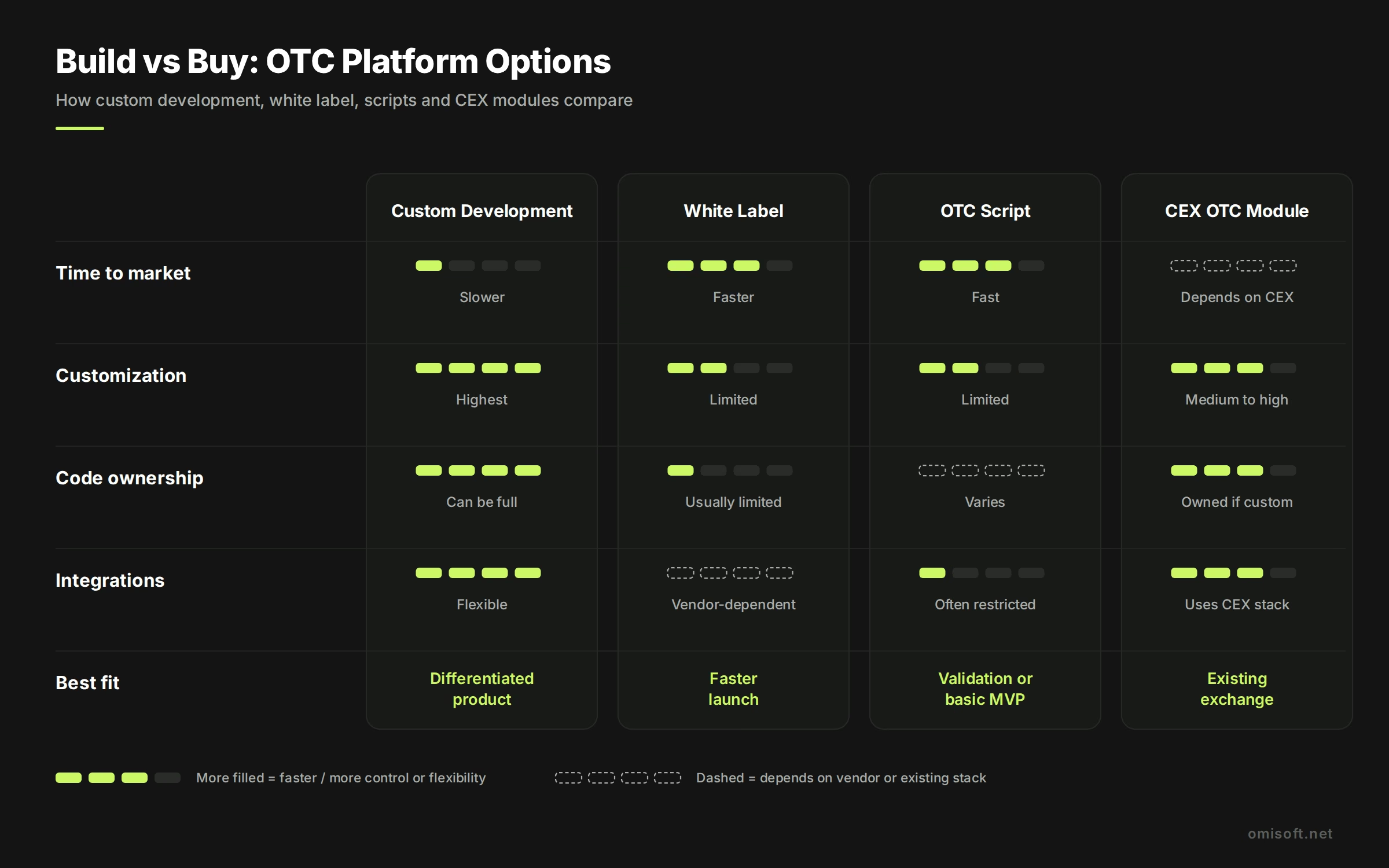
The choice between a custom OTC platform, a white label solution, an OTC crypto exchange script, and an OTC module for an existing exchange comes down to how differentiated the product must be, how fast it must launch, and how much control the business needs over code, integrations, and data.
| Custom Development | White Label | OTC Script | CEX OTC Module | |
| Time to market | Slower | Faster | Fast | Depends on CEX |
| Customization | Highest | Limited | Limited | Medium to high |
| Code ownership | Can be full | Usually limited | Varies | Owned if custom |
| Integrations | Flexible | Vendor-dependent | Often restricted | Uses CEX stack |
| Scalability | Designed for requirements | Vendor-dependent | Variable | Depends on CEX |
| Best fit | Differentiated product | Faster launch | Validation or basic MVP | Existing exchange |
Custom development fits a business whose execution model, client base, or settlement setup is part of its competitive edge, or which needs full control over code and integrations. The trade-off is time and upfront investment.
White label fits companies that need to launch quickly with a standard feature set and can accept the vendor’s roadmap, supported integrations, and commercial terms. It is worth checking what migrating away would involve before signing, since leaving a white label vendor can require substantial rebuilding.
An OTC crypto exchange script can be suitable for validating demand or accelerating a basic MVP, but institutional use usually requires careful review of its security, ledger design, custody model, scalability, code ownership, and integration limits. Businesses with proprietary execution workflows or complex integrations may be better suited to custom or hybrid development.
A CEX OTC module fits exchanges that already have onboarding, wallets, compliance, and client accounts. The OTC layer reuses that stack and adds RFQ, pricing, dealer tools, and block-trade workflows. Its limits come from the existing platform’s architecture.
There is also a middle path: a custom core for the parts that differentiate the business, such as pricing, dealer tools, and the client experience, combined with established third-party providers for custody, compliance, and some liquidity.
The choice depends on business model, budget, differentiation requirements, regulation, integrations, and existing infrastructure.
How Long Does OTC Trading Platform Development Take?
OTC trading platform development time depends primarily on whether the project is an OTC module, a basic standalone RFQ product, or a full institutional platform. These are different projects, not different speeds of the same project.
A simple RFQ MVP with a client portal, basic admin tools, a small number of liquidity providers, prefunded accounts, and integrated KYC and screening is the smallest meaningful standalone scope. A full institutional platform that adds streaming prices, FIX connectivity, smart order routing across many providers, hedging, credit or off-exchange settlement, automated Travel Rule messaging, and multi-entity reporting is a much larger program that is usually delivered in phases. An OTC module for an existing exchange can be faster than either, because it builds on existing accounts, wallets, and compliance, but it depends on how cleanly the existing system can be extended.
Third-party integrations are often a major source of timeline uncertainty, since liquidity providers, custodians, banks, and compliance vendors each have their own onboarding, contracts, and sandboxes outside the engineering team’s control.
The practical approach is to agree on an MVP scope that can process a real trade end to end, launch it with a limited client group, and add capabilities in planned phases.
Choosing an OTC Crypto Exchange Development Company
Choosing an OTC crypto exchange development company means checking whether the vendor can design a financial system, not just build interfaces. Many agencies can build a portal; fewer can design a quote lifecycle, ledger, and settlement flow that hold up under real money and audits. Check whether the vendor can:
- Design the execution model, not only the frontend. Ask how they would structure the RFQ lifecycle, quote expiry, and principal, agency, or matched-principal flows for your case.
- Work with liquidity integrations. Ask about experience connecting exchange, market-maker, or broker APIs, and how they handle provider failures mid-trade.
- Design a financial ledger. Ask how they model balances, reservations, fees, and reconciliation, and how they keep the ledger consistent under concurrent activity.
- Integrate custody and settlement. Ask which custody and wallet infrastructure they have integrated and how they separate ledger state from on-chain state.
- Implement compliance flows. Ask how onboarding, screening, and Travel Rule messaging fit into the trade and transfer workflow, and how rules can vary by jurisdiction.
- Provide security and auditability. Ask about RBAC, maker-checker approvals, audit logs, key management, and how they approach security testing.
- Integrate existing exchange infrastructure. If you run a CEX, ask how they would add OTC without destabilizing it.
- Transfer source code and IP as agreed. Clarify ownership and handover terms before signing.
Specific architecture choices and trade-offs are a better signal than a feature list.

Before Talking to a Development Company, Define These 7 Things
- Who will trade? Hedge funds, brokers, corporate treasuries, or your existing exchange users?
- Principal, agency, or matched principal? Will you take the other side of trades or route them to liquidity providers?
- Where will liquidity come from? Which exchanges, market makers, or brokers, and how many at launch?
- How will assets be held? Own wallet infrastructure, a third-party custodian, or both?
- How will trades settle? Prefunded, on credit, or through an off-exchange settlement network?
- What jurisdictions are targeted? Where are you licensed or applying, and where are your clients?
- Is this standalone software or part of an existing CEX? What can be reused and what must be built?
Clear answers to these seven questions make estimates more accurate and discovery shorter.
OTC Crypto Exchange Development Services with OmiSoft
OmiSoft builds fintech and blockchain products end to end, from discovery and architecture to development, QA, and DevOps. For OTC projects, that covers the capabilities an OTC platform actually depends on.
Trading infrastructure. RFQ and execution workflows, transaction processing, trading dashboards, and admin and dealer interfaces for operating the platform day to day.
Crypto infrastructure. Wallet and custody integrations, deposit and withdrawal flows, and blockchain infrastructure across major networks, supported by our Web3 development practice.
Fintech integrations. KYC and compliance services, payment and banking providers, liquidity sources, and other third-party APIs, connected with failure handling and monitoring.
End-to-end development. Discovery, architecture, UX/UI, frontend and backend development, QA, and DevOps, delivered by one team so that business rules, ledger design, and integrations stay consistent.
Our adjacent digital-asset exchange experience includes work for Ouinex, a multi-asset exchange. OmiSoft built a Telegram Mini App integrated with its existing exchange backend, covering secure authentication with two-factor verification, a real-time dashboard with balances and transaction history, deposit and withdrawal flows, and in-app KYC verification. We have also delivered decentralized exchange products such as Venom DEX.
If you are scoping an OTC platform or an OTC desk for an existing exchange, we can start with the decisions above and turn them into an architecture, a phased scope, and a development roadmap.


