

Crypto Wallet Development Company
We build production-grade, non-custodial crypto wallets for iOS and Android — multi-chain from day one, with a security model you can actually sign off on. EVM, Solana, and TRON supported at MVP. Whether you need a standalone mobile wallet, a white-label product, or an embedded wallet layer inside your existing app — we design the system around your chains, your users, and your compliance requirements.
Get a Free Consultation

Wallet Types
Crypto Wallets We Build for Web3, Fintech and Enterprise Teams
From standalone mobile apps to embedded wallet layers — we build around your product model, not a one-size-fits-all template.

Multi-Chain Non-Custodial Wallet
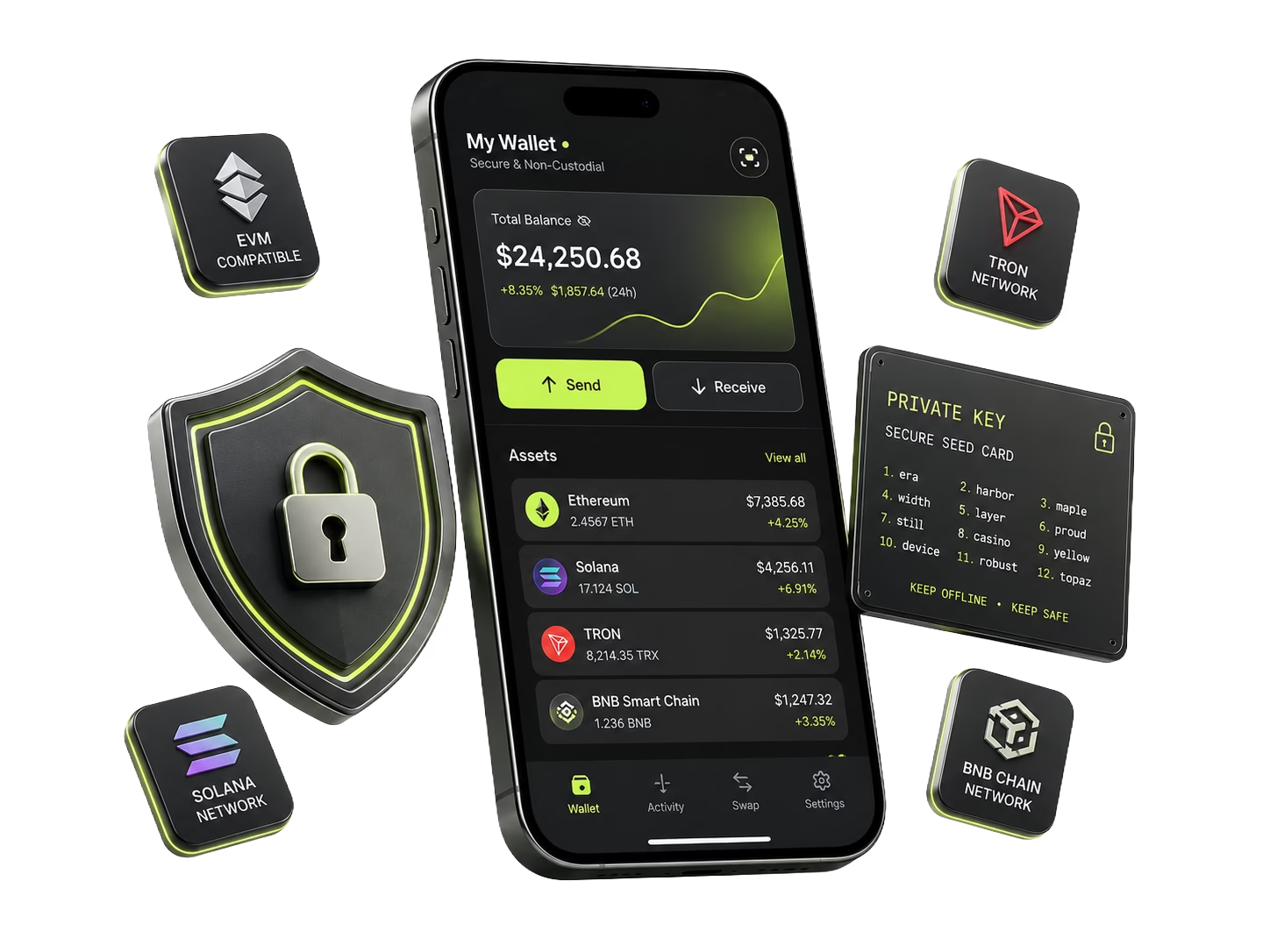
Private keys stay on the device. One seed phrase manages all networks — EVM (Ethereum, Polygon, BSC, Base, Arbitrum, Optimism, Avalanche), Solana, and TRON out of the box. Built for users who want full control over their assets.
Included functions
Scoped Individually
Learn More

DeFi & Web3 Wallet
A wallet built for on-chain activity — token swaps, LP interactions, staking, and dApp connections via WalletConnect. Designed for users who do more than just hold.
Included functions
Scoped Individually
Learn More

White-Label Mobile Wallet
Your brand, your token list, your UX — on top of a production-ready wallet core. Faster to market than building from scratch, without the risks of a generic script.
Included functions
Scoped Individually
Learn More

Embedded Wallet for Web3 Products
A wallet layer that lives inside your existing app or platform — no separate app install, no context switch. API-first, with custodial or non-custodial key models depending on your product requirements.
Included functions
Scoped Individually
Get in Touch

Telegram Wallet
A crypto wallet as a Telegram Mini App — send, receive, and manage tokens directly inside a chat. No app store friction, instant distribution to your existing Telegram audience.
Included functions
Scoped Individually
Get in Touch

Blockchain Wallet for Enterprise
Multi-signature flows, policy-based transaction controls, audit logs, and role management — built for teams that need more than a personal wallet. On-chain operations with governance and accountability.
Included functions
Scoped Individually
Learn More

Core Features
Crypto Wallet Features That Support Security, Scale and User Trust
A wallet is only as good as what happens under the hood. These are the four engineering areas where most wallet projects cut corners — and where we don't.

Security Architecture
Private keys are encrypted with AES-256-GCM and stored in iOS Keychain or Android Keystore — never in plain text, never on a server. PBKDF2 key derivation, per-operation IV, and brute-force lockout are built in by default.

Transaction Reliability
Every transaction follows a strict lifecycle: build → validate → sign → broadcast → monitor → confirm. Status is tracked in background and foreground so the app never loses a transaction — even when the network does.

RPC Resilience and Failover
When an RPC provider fails or rate-limits, the wallet switches automatically — no user action, no stuck screen. Health checks run continuously, provider state is cached, and 429 errors trigger immediate rotation.

Backup and Recovery
Wallets are recoverable via BIP39 seed phrase. Optionally, an encrypted backup can sync to iCloud or Google Drive — encrypted client-side before upload, with a cloud password that is separate from the app PIN.
Our Cases
Relevant Web3 and Mobile Products We've Shipped
Crypto wallet development sits at the intersection of mobile engineering, blockchain protocol knowledge, and security design. Here's what we've built.
Build Your Wallet With Us
Crypto
Secure Multi-Chain Crypto Wallet with Fiat Integration and Cross-Chain Trading
Developed a Colombian cross-chain crypto wallet with major blockchain integration, fiat on-ramps, and full app store compliance.
2500 +
hours of development
85 K
Project Budget
7
person expert team

Crypto
Blockchain Decentralized Exchange Case: Custom App Development
Venom is a decentralized crypto exchange that allows users to swap tokens, manage liquidity pools, and earn rewards on farming.
250 K
unique users per month
6
months of project maintenance
99.95 %
Uptime Ensured high stability of the product with the help of AWS

Telegram App
Ouinex Telegram Crypto Trading Bot Development for Effortless and Secure Crypto Trading
Ouinex is a centralized crypto exchange (CEX) focused on transparency, speed, and institutional-grade trading infrastructure.
To make crypto trading more accessible, Ouinex partnered with OmiSoft, a crypto trading bot development company, to build a Telegram-based trading app that allows users to manage accounts, trade, and handle funds without leaving the messenger.
45 %
faster user onboarding
30 %
higher engagement rate
0
security incidents post-launch

What We Do
Full-Stack Crypto Wallet Development Services
We cover the full product and engineering stack — from key management architecture and blockchain integrations to mobile app delivery and App Store submission. No handoffs to third-party teams mid-project.
Contact Us
Wallet Architecture & Key Management
HD wallet implementation with BIP39 mnemonic generation and BIP32 derivation paths per network. Multi-account support, Ed25519 for Solana, secp256k1 for EVM and TRON. The foundation everything else depends on — we get it right before writing a single UI component.

Blockchain Integration & RPC Layer
Network adapters for every supported chain: ethers.js v6 + viem for EVM, Solana Web3.js for SPL tokens, TronWeb for TRC-20 and bandwidth management. RPC failover, health checks, and provider caching built in — see our blockchain wallet development services. Adding a new EVM chain takes hours, not weeks.

Security Infrastructure
Encryption layer with AES-256-GCM, PBKDF2 key derivation, and per-operation IV. Platform secure storage on iOS (Keychain) and Android (Keystore). Biometric authentication as a second unlock layer. Keys are cleared from memory immediately after signing — the foundation of our non-custodial wallet development approach.
Mobile App Development (iOS & Android)
React Native with TypeScript — one codebase, two stores. We handle the full delivery: UI implementation, MMKV encrypted storage, background transaction monitoring, deep linking, and App Store / Google Play submission with security documentation ready for review.

White-Label & Embedded Wallet Delivery
For teams that need a branded product or a wallet layer inside an existing app. We deliver full source code, adapt the UI to your design system, and configure chain support, token lists, and backend connections to your specs.

Pricing
Crypto Wallet Development Pricing
-
 Single-chain or dual-chain support (e.g. EVM + one network)
 -
Non-custodial key model, platform secure storage
-
Send / receive / transaction history
-
iOS or Android (single platform)
-
Basic security layer: PIN, encryption, seed phrase backup
-
Fixed-scope delivery, 8–12 weeks
-
EVM + Solana + TRON (or custom chain set)
-
iOS & Android from single React Native codebase
-
Full security stack: AES-256-GCM, Keychain/Keystore, biometrics, brute-force lockout
-
RPC failover and provider management
-
Cloud backup (iCloud / Google Drive), encrypted client-side
-
Background transaction monitoring
-
App Store & Google Play submission with security docs
-
14–18 weeks
-
White-label branding, custom UI/UX, your token list
-
Embedded wallet layer or SDK delivery
-
MPC key management or multi-sig flows
-
Additional chains, DeFi integrations, WalletConnect
-
Compliance and KYC/AML layer
-
Dedicated team, post-launch support SLA
-
AI Automation
-
Integration of Polymarket Module
Not sure which wallet architecture fits your product?

Tailored Solutions
Crypto Wallet Architecture Options: Non-Custodial, MPC, White-Label and Embedded
Different products need different key models. The architecture you choose affects security, user experience, compliance requirements, and time to market — here's how each option works.

Why Teams Choose OmiSoft for Crypto Wallet Development
We've shipped a production multi-chain wallet. That means the architecture decisions, security tradeoffs, and chain-specific edge cases aren't theoretical for us — they're solved problems we bring to your project.
From Idea to Launch: Let's Build Your Wallet.
Max

CTO, Expert in Crypto Wallet Development


FAQ
Frequently asked questions
What is a non-custodial crypto wallet and why does it matter?
In a non-custodial wallet, private keys are generated and stored on the user's device — no third party holds them. This means only the user can access their funds. For products where user trust and asset security are priorities, non-custodial is the standard model. Custodial wallets are faster to build but introduce custody risk and regulatory complexity.
Which blockchains can you support in a single wallet?
Our production stack covers EVM networks (Ethereum, Polygon, BSC, Base, Arbitrum, Optimism, Avalanche), Solana, and TRON. New EVM chains can be added quickly. Non-EVM chains require a dedicated adapter but don't affect the existing core. For a deeper look at our chain integrations, see our blockchain wallet development services.
How are private keys protected on the device?
Keys are encrypted with AES-256-GCM using PBKDF2-derived keys and a random per-operation IV. They are stored in iOS Keychain or Android Keystore — never in plain text, never on a server. Keys are cleared from memory immediately after signing.
What is the difference between a white-label and custom wallet?
A white-label wallet is a production-ready core with your branding and configuration applied on top — faster to market, lower cost. A custom wallet is built around your specific architecture, chain set, UX, and business logic. Both options deliver full source code with no vendor lock-in.
How long does it take to build a crypto wallet app?
An MVP wallet on a single chain typically takes 8–12 weeks. A production multi-chain wallet for iOS and Android is 14–20 weeks. Timeline depends on the number of supported networks, security requirements, and whether custom UI/UX design is included.
How much does crypto wallet development cost?
MVP wallets start from $25,000. Production multi-chain wallets with full security stack start from $55,000. White-label and enterprise projects are scoped individually. The main cost drivers are the number of supported chains, security depth, and delivery scope.
Can a crypto wallet pass App Store and Google Play review?
Yes — if the security model and documentation are prepared correctly. We include App Store and Google Play submission in our delivery scope, along with the security documentation that reviewers require for crypto applications: key storage rationale, encryption references, and OWASP MASVS alignment.
What is the difference between custodial and non-custodial wallets?
In a custodial wallet, a third party holds the private keys on the user's behalf — similar to a bank. In a non-custodial wallet, the user holds their own keys on-device. Custodial models are simpler to recover but introduce custody liability. Non-custodial models put full control with the user but require solid key backup UX.
Do you support MPC wallets for enterprise use cases?
Yes. MPC (Multi-Party Computation) splits the private key between the user's device and a server — neither side holds the complete key. This eliminates seed phrase risk and enables policy-based controls, making it suitable for enterprise platforms, institutional products, and B2B custody services.
Can a crypto wallet be integrated into an existing mobile app?
Yes. We build embedded wallet layers that live inside existing applications — delivered as an SDK or API integration. The key model (custodial or non-custodial), supported chains, and UX are configured to fit your product. No separate app install required for the end user.
Who owns the source code after delivery?
You do. Full source code ownership is transferred at project completion. No licensing fees, no vendor lock-in, no dependency on OmiSoft infrastructure to run the wallet.
